Monday, March 17, 2014

Make your own candied peel

Candied peel is an ingredient that pops up a lot in winter and springtime British recipes - from Christmas cakes to hot cross buns. It can also be quite expensive to buy in the shops, and difficult to come by in most places in Japan, so it's definitely something I wanted on the handy "make your own..." list. Most of all I just really like the idea of a nose-to-tail style of no-waste baking. Let's have more of that please!


I made this batch on one of the recent snowy Tokyo days with a view to using them in hot cross buns coming up in April. Here is the method I used.

Candied orange peel - Ingredients
  • 3 large oranges (you could do this with other citrus fruits too)
  • 200 ml water (plus extra for initial boiling stages)
  • 450g sugar, and extra caster sugar to dust 

Method

First peel your oranges. I used just 3 large oranges for quite a lot (300g+) of peel. If you cut off the ends and score lines down the sides of the oranges then you get nice shaped pieces to work with.


How thin you want to slice depends whether you will use them for decoration or for chopping up and going into bread or cake batters. Mine is the latter and so I went quite chunky.


Put the peels in a saucepan, cover with water and bring to the boil twice, discarding the hot water each time.


Next, measure the recipe's sugar and water into the pan and then bring to a simmer.


Add the peels and return to a simmer.


Heat like this for about 1 hour or until translucent and then drain off the syrup.


Dry the slices separately as much as possible, so they don't stick together.


I found that dredging with sugar worked best after the slices were cold and somewhat dry already. If you dredge too soon, the sugar melts in a thick layer on the peel, but what you want to see, is granules of unmelted sugar, coating the peel.


Eat a couple as they are, dip some in dark chocolate as very sugary snacks, or store in a ziplock bag for when you make your hot cross buns.

These peels should keep very well at room temperature for a few weeks, some people manage to store them for months if they have been well saturated with syrup in the boiling stage, dried very well before storage and then stored in an airtight container. Until I have better evidence to the contrary I would say that if you are planning to use them more than a month later, like me, then freeze them to be on the safe side, as they can go moldy.


Friday, March 7, 2014

Checking the hazard level of your Tokyo location

Just a quickie post today. I found out about this a little while ago and have been meaning to get around to posting about, as other people might find it useful too.

Hazard maps, as modelled by Melvyn

Minato-ku ward office (and presumably other ward offices too) have released various hazard maps, to help prepare for the occasion of a large earthquake hitting central Tokyo. If you're in the middle of looking to sign up for a shop space, or moving house, it's worth a look to see if there are areas you might want to consider over others.


You can get big paper copies of these maps from the ward office directly, here is what they are called:
  • 津波ハザードマップ / tsunami hazado mappu / tsunami hazard map
  • 液状化マップ / ekijyouka mappu / liquefaction risk map
  • 揺れやすさマップ / yureyasusa mappu / map showing how shakeable areas are likely to be
  • 浸水ハザードマップ / shinsui hazado mappu / flood hazard map
You can also look online at pdfs of these documents (links to the English versions above), and they are available in English as well as Japanese. 

Wednesday, March 5, 2014

Fitting out your shop space in Tokyo

So.. we have a space! I've been looking casually for a couple of years and seriously since the end of summer last year, and just a couple of weeks ago came across a beautiful little space that was within budget, our application was approved and we have just signed and got the keys!

Even before you apply for a space, it's useful to know some of the requirements and terminology for fitting out the space to have it meet your needs and the requirements of your local health department (保健所 / hokenjyo).

Measuring out the space

If you're looking online in Japanese, fitting out a shop space is called 内装 / naisou, and this is often carried out by a contractor called a 大工さん / daiku-san (joiner/carpenter), or a 建築家 / kenchiku ka (architect/builder). In some cases you'll go through a 'designer' who would work with you on a plan for the space then probably have a team of daiku-san, and other workers to carry out the practical tasks. I've heard of people fitting their spaces out themselves too.

If you can meet the contractor at your space, or the space you're planning to apply for, they should be able to give you a detailed quote for the work you would like carrying out. Bear in mind that equipment (設備 / setsubi) and kitchen equipment (厨房機器 / chubou kiki) won't be included in that quote, and that some specialist work related to gas and electricity may need to be carried out by other people and be charged for separately.

I've seen it written on Japanese forums about reform and space-fitting that a general rule of thumb to calculate is about 100,000 yen per tsubo (坪) of space for the most basic naisou work (this would be roughly 30,000 yen per square metre). This would mean a 25m place is looking at a 750,000 yen before materials and equipment are included. Of course you'll find spaces and contractors that will need more or less than this, and it depends on what you want them to do, and what is required by the local hokenjyo as well.

If you look at the hokenjyo requirements for a food business permit you can see that they fall into a few main categories. Please note that the information to follow is just based on my individual understanding at present, and is not an exhaustive list. Please consult with your own health department and with professionals for definitive guidance. Here are just some thoughts to help you get started:

Plumbing 排水 / haisui
  • If your business uses a lot of oil, for frying etc., then your hokenjyo will probably require you to have a drain in your kitchen floor. If there isn't already one in the space, or if you can't make one as you are above the ground floor of a building, then this involves creating a raised platform for the kitchen, and fitting a drain under that platform. Prices for this work are likely to start from a few hundred thousand yen, but will vary from space to space.
  • Grease traps are not specifically required by most hokenjyo, although they are a good idea, for the environment and to avoid blocking up the neighbourhood's pipes. However there is a chance that another body, such as the water company may ask you to fit one depending on your type of business. Grease traps can be fitted under the floor, or small sized ones can be placed under your sink.
  • Refer to your hokenjyo's requirements on specific numbers of and sizes of sinks. The staff hand-washing sink needs to have a fixed soap dispenser permanently attached to the sink.

Ventilation 排気・換気 / haiki, kanki
  • Your hokenjyo may require separate air conditoners in place for the customer area and the kitchen area. Consider the need for 200v plug sockets and ventilation pipes to take the exhaust air out of the building. Also consider whether you can place air conditioner box on the outside of the building, and where.
  • You will need to fit an extraction fan, and if you have a gas range you will need this to be connected to an extraction hood of a suitable size over your gas range.
  • My hokenjyo requires that all wall and ceiling surfaces in the kitchen area are flat and easy to clean. This means that exposed pipes, especially the round ones that carry exhaust air out of the building, will need to be boxed-off so that all surfaces are flat. This is to prevent build-ups of dust falling into food you are preparing.

Electricity 電気 / denki
  • What is the current amperage level for the property? Look at the electric breaker box at the property and you'll see 20A, 50A etc. Amps x Volts = Watts means that a 20A property running on a regular 100V Japanese 単相 / tansou / single phase circuit system has a total maximum capacity of only 2000 Watts. In addition the total *safe* capacity should be only up to 80% of that amount so this example actually only allows you to use 1,600 watts safely, which isn't much if you are planning to use an electric oven.
  • Calculate your electrical load capacity needs by adding up the wattage for each of the pieces of equipment you plan to use, not forgetting anything already in the space such as lighting. The wattage information is available on the product label itself, and in the manuals.
  • The amperage for your property can usually be increased if you require it, check if it's ok with the building owner and consult with your electric company and contractor. Your electricity provider will carry out the work (the lady at Tokyo Electric said it takes about 20 minutes and is usually free for 100V systems) and your contract with the company will also need to be increased. For Tokyo Electric, 60A appears to be the maximum available for 100V systems - but it will depend on your property.
  • In addition to single phase electricity, some properties also have commercial-use 3-phase (三相 / sansou) systems in place. I'm not completely in-the-know about these yet, but believe the rate of electricity is cheaper than single-phase, but that you'd probably have the two systems running concurrently and pay two electric bills each month. Even if you have a single phase system, it is possible for your electrician to use it to fit some 200V sockets (for some air conditioners and electric ovens etc.). 
  • Lighting in the kitchen also needs to be flat and easy to clean. Fluorescent tubes for example need to have box covers over them.

Gas ガス
  • Even if there is a gas pipe in the property, check whether the property has a gas meter or if you will need to have one fitted. If you can't find the meter then you can ring the gas company to ask if the address has been previously registered for gas and they should be able to tell you.
  • Also see above regarding ventilation.

Knowing the activities you plan to carry out and the requirements of the hokenjyo to allow you to do them, should be able to help you choose a space with a fuller knowledge of the likely total cost. Go along to a local hokenjyo to ask specific questions you may have even before you have your space.


As for me, lots of work to do... more updates to follow!

Tuesday, February 18, 2014

I'm so excited!

I'm so excited I can hardly stand it! If you'll excuse me for a brief moment, I think I need to be a little bit un-British for a moment.

One of the reasons for wanting to start my own business was to meet other people who care about what they do, and together to create something positive for others. (I recommend the book Business Model You for its personal mission planning activities for uncovering what really drives you.)

I haven't even properly got going with the business, but it has already been such an amazing ride.

It started slowly, from 2011 when I started writing this blog. People got in touch now and again, people with similar dreams looking for help, people who were enthusiastic about the same things as I am, and other businesses looking to make connections. It's always great to hear from good people.

Then I got to meet the warm and formidable members of the Bramley Apple Fan Club, and through them learn the amazing history of this British fruit and meet not only the people instrumental in bringing the Bramley to Japan (to whom I will be forever grateful!), but also the British family connected to the Bramley's very existence.  

It's all somewhat beginning to snowball as more connections are made, and every week I'm in touch with truly kind and inspirational people and I'm learning so much. The generosity and collaborative spirit is incredible and I frequently catch myself feeling how lucky I have been already.  

I'm now meeting passionate bakers, advocates for real food and for British and Japanese culture, writers, teachers and fellow learners, all with shared enthusiasm for creating something positive. 

I've got such a feeling of excitement, this is going to be great! 

Ahem. Now I can just calm back down a bit. :)

Saturday, February 8, 2014

Oranges project - marmalade, candied slices and caramelised segments

I had a beautiful big bag of oranges and a plan to make candied peel (recipe to follow soon) for hot cross buns coming up in April. This would use just the skins of just 3, and so I looked around for some other exciting things to do with the remaining fruit. The result was a bit of an 'orange project day' in the kitchen, producing marmalade, candied orange peel and slices, and caramelised orange segments. All that hot syrup and bright fruit is the perfect way to warm yourself up on a chilly February day!


Firstly, Lily Vanilli's Sweet Tooth book has a a lovely and simple way to use up the orange segments left over from making candied peel. After removing the segments one by one from the peeled orange, you melt sugar in a pan to make caramel and stop it with juice from the fruit.


Stir in the segments once the caramel is cool. We tried them with yoghurt honey and granola and they were lovely.


Next up was the marmalade. I used Dan Lepard's excellent recipe although my oranges were not the bitter Seville variety called for to make a proper marmalade. I wonder if we can get bitter oranges in Tokyo? Surely we can..!


Soaking the orange slices overnight

This recipe involved soaking the squeezed and sliced oranges in their juice plus water. I was supposed to soak the pips separately in a cup of water, but my oranges had no pips! Or I should say, the pips were so tiny as to be insignificant. Still, there was no problem with the mixture setting at the end and so it didn't appear to be a problem.


Dan has us boiling the slices for 2-3 hours without the sugar until the peels are soft and squishy. Once the sugar (white, and 2 teaspoons of brown sugar) and lemon juice are added, the mixture boils up considerably and the consistency changes from watery to syrupy as the water boils off and the amount of sugar in the mixture is concentrated.


We're supposed to boil the marmalade until it reaches 105C, let it cool slightly and then transfer to sterilised jars. I quite liked this non-bitter orange version of marmalade, there was a little bit of pleasing bitterness to it still, perhaps from the pith. Lovely on toast!


Finally another Vanilli recipe to use up the remainder of the oranges, candied slices. You prepare a simple syrup of water (300ml) and sugar (125g) and boil the fruit in it until they start to become translucent. This took about 1 hour. For French-style fully candied fruit that is hard and has a long shelf-life, you would need to boil them over a number of days to replace all of the water content with super-saturated syrup. These are a little more delicate, still being quite soft, and they would look smashing on chocolate cake or on top of an orange-drizzle cake.


There we go, a a bit of a nose-to-tail day of cooking with oranges, and an awful lot of sugar!

Now I fancy having a go at the hot marmalade pudding from the Hawksmoor cook book, or perhaps this one. Sounds very wintery and special, especially with a boozy sauce.


Wednesday, February 5, 2014

Murasaki imo buttercream birthday cake

I'm currently looking for a space for my business (exciting stuff, what!), but the other day a friend asked me to make a special birthday cake for a friend.

After looking at various chocolate and carrot cake recipes I based the cake on this amazing 3-layered Victoria sponge cake by Peggy Porschen. I didn't want to use food colouring in this cake, and I didn't want to use quite as much buttercream as the original recipe, we also wanted something that looked more contemporary than classic, to match our friend's personality.


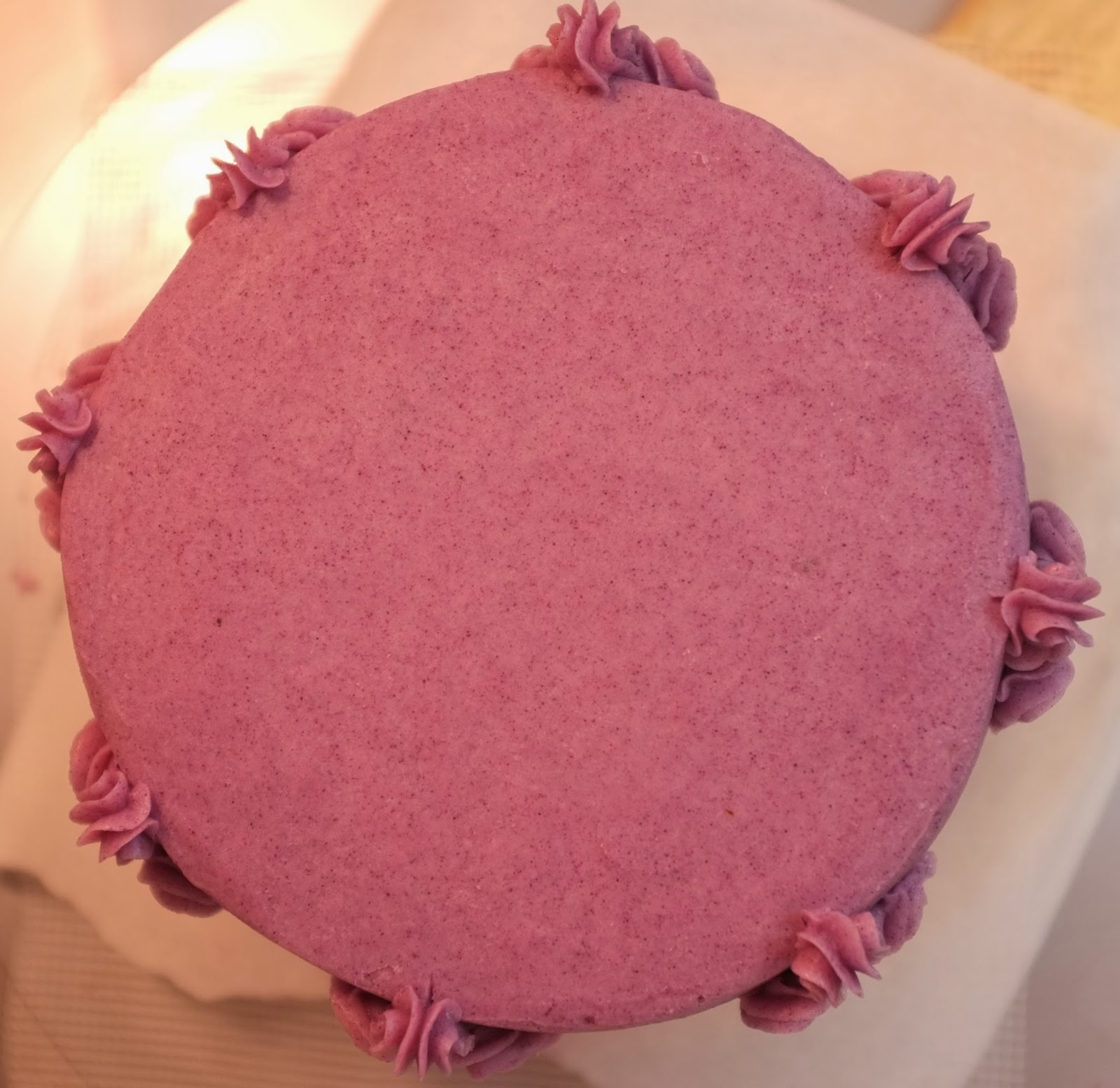
The gorgeous purple colour is all from powdered murasaki imo (purple potato) which is often used in confectionery in Japan (it is even a Haagen Daz flavour). I had most if 20g sachet left over from recent macaron experiments and didn't need the full amount. It imparts a very delicate sweet and earthy flavour to the buttercream, very nice. I also liked that you can still see the vanilla seeds in the mixture. 


A handy tip when using real vanilla beans is to rub the beans from the scraped pod into some of the sugar you are using in the recipe, in this case icing sugar in the buttercream, as it will help to avoid too many of the seeds clumping together.

Rubbing vanilla seeds into the sugar

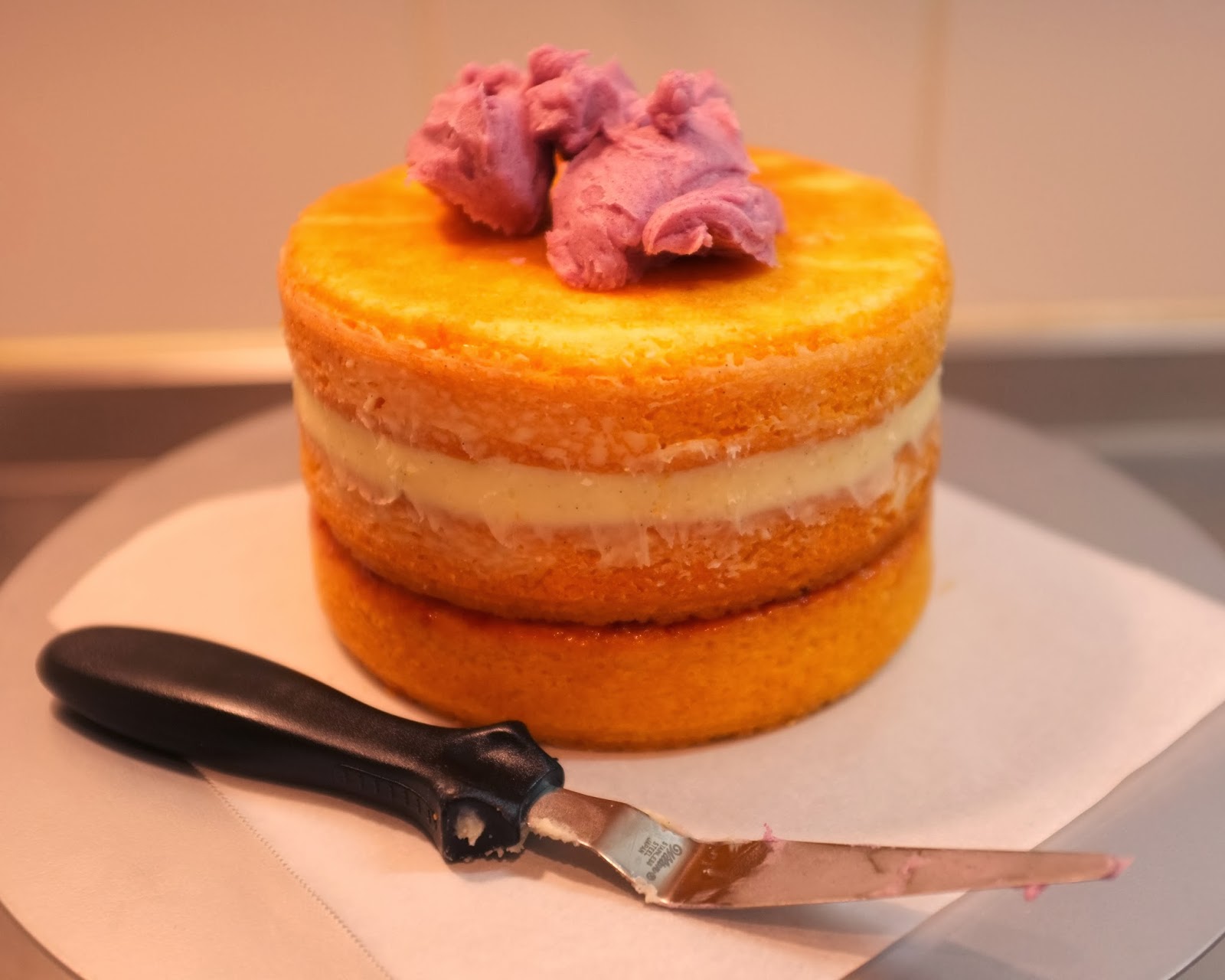
The process of making the cake is very thoroughly explained in the linked-to recipe above. Here are some photos showing the step-by-step process as I took it. First trimming, filling and stacking the sponges. The first layer is spread with raspberry jam and the next with a portion of buttercream I'd kept separate from the murasaki imo powder.


Next came smoothing on a crumb-coat, an undercoat for the buttercream, to help make the final layer as smooth and straight as possible. Once you have the thin crumb-coat on, you chill the cake before applying the next layer.


Crumb coating of buttercream

While the cake was chilling between coats I had a bit of a practice piping the fleurs-de-lis on a dummy cake, but I rather feel that lots of practice is required to get the gracefully-sweeping shells of the original recipe.

Practice, practice...
 
Divide the cake in advance to know where to pipe


To avoid having too much buttercream on the cake, I topped it with a purple anemone (wind flower) I'd made out of gum paste somewhat loosely based on one I'd seen in the supermarket a few days earlier.


Just being the one flower I was able to bend the floral tape-wrapped wires around to make a kind of stand for it to lean on, so we could place it directly on top (usually you would insert a flower spike into the cake itself and put your fresh or sugar flowers into that plastic spike). The gumpaste rested on the buttercream just fine - I had wondered whether the moisture in the frosting would soften the gumpaste, but it held up fine when I tested a batch for 24 hours.


This was quite an extravagant version of a Victoria sponge cake. With the real vanilla, vanilla syrup-soaked sponges, multiple layers and lots of buttercream, it certainly fit the bill for an extra special birthday cake!

Making the vanilla syrup

Thursday, January 9, 2014

Omotenashi - little things that make big difference

Ordering some bits and pieces online for a sewing side-project I was struck by the little extras that were included in each delivery.


You see, I had ordered from a few different companies, but each item arrived with a little 'something extra', for free, and this really pleased me. Ribbons I'd ordered came with an extra sequined thread with "For You" on the packet, and these Liberty fabric samples arrived with this crazy-cute Hello Kitty swatch with a little note.

Little extras packaged with Liberty fabric and ribbons

If I think back, quite often when I've ordered things online there will be a little cute card in there, or a tiny package with one or two biscuits, or a recipe card.

It's not just online either - when you're at a restaurant you'll sometimes get given a サービス / service item (in Japanese "service" pronounced in English means complimentary, for free), like when we were the only customers in a bistro in Ebisu and they gave us "service espressos".  Think about times when you've had something like a packet of tissues or a mini soap bar put into your bag at the checkout at a drugstore, or been given free square of chocolate on leaving a restaurant. Once we even came away with a small bottle of "service" olive oil, as we'd liked it so much at the table!

I've been thinking about it and fumbled around a bit with ideas like 'they like to delight people here' and 'it's the excellent service culture here' before I hit the nail on the head. It's おもてなし omotenashi (kanji for this is rarely used but is お持て成し - to carry and to achieve).

The article linked to above explains it nicely, but in its simplest sense I feel it means doing something nice for someone that they didn't ask for. In customer service this is often described as anticipating the needs of the customer before they do and delivering generous hospitality. It's often also described as being selfless, which sounds like a subservient, surrendering mindset - I'd argue that choosing to act in this way, particularly in face-to-face encounters requires an assertive mindset, empathy and confidence.

Perhaps some of how this is employed today in business might be a little more cynical, as doing it 'without expecting anything in return' is not justifiable for purely logical businesses, and so customer loyalty, further sales and so on are probably expected results.

However I do get the feeling that carrying out omotenashi is a genuine pleasure for many people, and that the delight felt by the recipient is as much as was hoped to be achieved.

Certainly, even after almost 13 years these little gestures still manage to surprise me and are one of the things that make living here a pleasure.