Showing posts with label Flours. Show all posts

Thursday, April 11, 2013

Japanese bread flour tests - koumugi, haruyutaka and someiyoshino

I finally got around to testing out the remaining Japanese white bread flours I’d ordered. After the initial surprisingly different taste of the kita no kaori flour blend that I tested a little while ago, I wanted to make a few loaves at the same time using exactly the same method and starter, to compare them side-by-side like a wine tasting.

My flight of sourdough boules for taste-testing

This necessitated the purchase of a few more large bowls and I was pleased to find the large 100 yen shop in Harajuku had bowls big enough to do the trick. Sourdough starter can react with metals (that link is a good read right there), and so go for plastic or glass bowls when you can, and if your jam/mason jars have metal lids, sneak a layer of clingfilm between the lid and the jar when you loosely (to let the gasses escape) affix your lids to avoid rust in your lid and off-notes in your starter.

The flours I tested were as follows:
  • A 日清製粉カメリヤ / Nisshin strong flour, camelia. (My control, the regular flour I've most frequently used to date, made from North American wheat)
  • B キタノカオリ / Kitanokaori blend is the one I tried out earlier (from Hokkaido, name meaning 'fragrance of the North').
  • C ハルユタカ / Haruyutaka (from Hokkaido. The name is usually written in katakana, but assuming that 'haru' and 'yutaka' have their usual meanings, this would translate as something like ‘spring abundance’ maybe?).
  • D 香麦 / Koumugi (from Hokkaido. The name sounds a little like the Japanese for wheat 小麦 / komugi, but with an extended ‘kou’ sound. It’s the same ‘kou’ kanji character as is used in perfume 香水 / kousui and so the name sounds like it means ‘fragrant wheat’).
  • E ソメイヨシノ / Someiyoshino (from Kyushu, the name is a type of cherry blossom).
  • F Shipton Mill No. 1 organic white bread flour (UK wheat, which I tested previously.)
– I told you they had great names. ;) There is another I haven't tried yet called 春よ恋 / Haruyokoi which is also from Hokkaido, and the name appears to be a play on words. It sounds like the name of a drama, a song and manga 春よ来い / haru yo koi which means ‘longing for spring’ or ‘come on, spring!’ but has instead the 'koi' kanji for love and so means something more like ‘spring passion’.


On with the tests! Based on the protein and ash content I might have expected the kitanokaori blend to behave similarly to the Shipton Mill flour I liked so much when I tried it in the UK. There was certainly a big difference in taste between the two however. In terms of other notable points, the someiyoshino flour was the highest protein of all those I've been testing, at 13.9% and Haruyutaka the lowest at 11.3%. The Shipton Mill flour had the highest mineral content and Nisshin camelia was the most refined white flour with the lowest ash content of all.

My starter was a little more lethargic than usual for these tests, with me not perhaps giving it enough warming and culture-proofing before I used it but with enough time it leavened the dough enough to produce some reasonable half-sized loaves.

For the method I split a regular 700g-ish basic sourdough loaf recipe in half and made 4 test boules using the same amount of starter, water and salt. I mixed in 200g of flour to start with and reserved 45g back to add during kneading depending if it needed it. Of all the doughs the control (Nissin) was the wettest and it took the whole 45g of additional flour. Koumugi was the driest flour to-touch and stiffest dough and so I only ended up using an additional 8g more. This dough was springy during kneading, but tore quite easily compared to the others which were more stretchy.


During their overnight proof the Nissin control flour dough and haruyutaka had spread out the most in their bowls, and koumugi remained the highest.

Tall koumugi is 2nd from the back

This remained the case after shaping final proof and baking - Haruyutaka was the flattest, most spread-out loaf and koumugi the tallest. Haruyutaka also had a noticeably more pliable crust than the other breads.

Koumugi crust

Someiyoshino crust

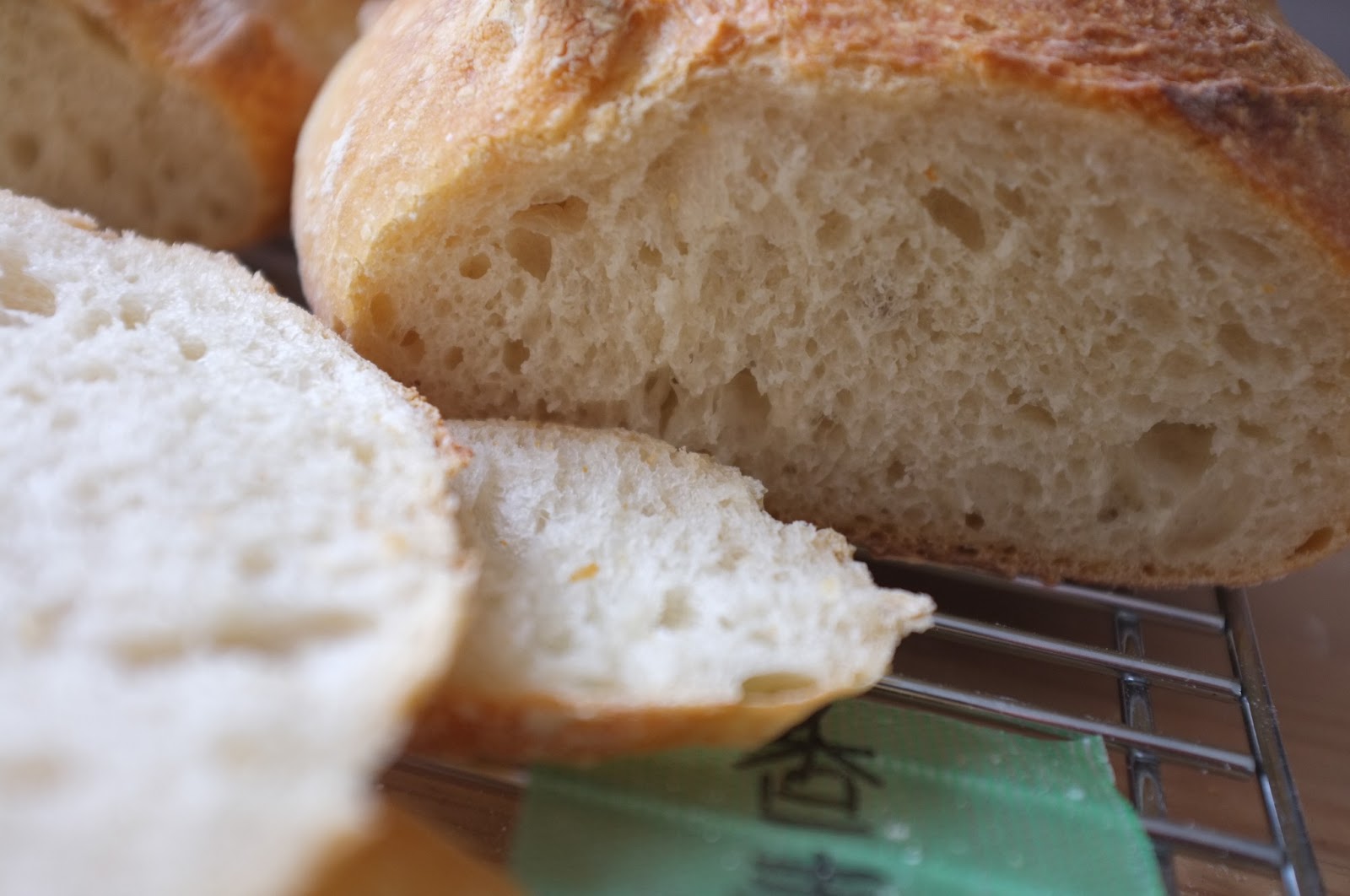
Other remarkable differences were that koumugi had a strangely flaky crust, in that some of the bubbles in the crust of the dough had shattered, something I hadn't seen before (1st photo above). Someiyoshino, the highest protein flour had unusual gelatinous starchy markings in the slashes on the crust (2nd photo above). The Nissin control loaf had the tightest crumb and mainly small bubbles with just a couple of larger ones, though this could be a feature of me having to shape it a few more times than the others, it being quite a slack dough. (Photos below, left to right are Nissin control, Haruyutaka, koumugi and someiyoshino. Same order also in the photo set below.)


Someiyoshino was the most remarkably different-tasting bread of the batch, it had a slight grassy taste and a slightly soapy mouth-feel on the finish. Still, it was a little more subtle tasting than the kita no kaori flour I tried out a few weeks ago and wasn't unpleasant.

Haruyutaka produced the palest loaf in this batch and was the closest in taste and texture to the control Nissin loaf. The crumb was the holey-est (holiest?) crumb with a few more bubbles on the large-side. None of the loaves were remarkably artisan-level holey, but that's fine with me as I get to keep more of the topping on my slice..

Koumugi was my favourite of the Japanese flours tested to date. The crumb was stretchy and springy, the loaf had risen the highest of the lot and there were no off-notes to disturb the enjoyment of the slight sourdough tang. The crumb was quite evenly bubbly with medium-sized holes.


I'd like to try out a few different recipes with these flours, see what they are like with different toppings or how they perform as flatbreads. I haven't yet had quite the same kind of epiphany I had with Shipton Mill flours, but they have made nice sourdoughs and I'll give it a few more tries!

Comparing the holes in the crumb


Wednesday, February 20, 2013

Japanese flour tests – Kitanokaori blend, Hokkaido bread flour

After my lovely experience in the UK trying out bread flour from Shipton Mill that was made with British-grown wheat I was excited to get back to Tokyo and try out some domestic Japanese flours.

Poppy seed sourdough made with Japanese flour

According to this grain industry article, almost 90% of Japan's wheat is imported. Most of the flour sold by Japanese brands in supermarkets here is milled from wheat imported via The Ministry of Agriculture, Forestry and Fisheries (MAFF) mainly from the U.S., Canada and Australia. 41% of the wheat imported is used for making bread and 32% used for noodles.

Most of the wheat grown domestically is from Hokkaido. You know, I've still not made it to Hokkaido after all my time here! When I first arrived in Japan I remember Hokkaido being likened to England, with lots of green grass (Tokyo grass is often more straw-like, sparse and stubbly), rolling hills and cows in fields... I think a trip is in order sometime soon, perhaps I can also find interesting suppliers for butter and so on.

I did a little research into a few of the domestically-grown varieties of wheat and picked a few blends of domestic bread flour to try out. Here is a comparison of the protein and ash content of these flours along with the Shipton Mill white bread flour and the Nissin strong bread flour I've used mainly to-date.


The domestic Japanese flours all have delightful names. My first test was with a kitanokaori blend (which I guess would translate as something like 'fragrance of the North', pertaining to it coming from Hokkaido). The Kitanokaori species was produced by cross-breeding Japanese Horoshiri and Hungarian GK Szemes wheat varieties.

The particular kitanokaori flour I bought is blended with 2 other types of domestically grown wheat (haruyokoi and kitahonami). It has a protein (蛋白質/ tampaku shitsu) content of 11.7% and ash (灰分 / kaibun) content of 0.53% - point B on the graph above. 
You can buy kitanokaori on Amazon JP, as well a number of online stores.


The Verdict -

In working with the flour to make a basic plain sourdough loaf, there was no immediate sensation of “wow this is different!” as I experienced when working with the Shipton Mill flour. Perhaps it was a little stickier/innately damper than the regular supermarket (Canadian/American) flour I’d worked with previously. During kneading it behaved less elastic despite having a similar protein content to other flours I've tried.


During proofing it rose a bit less than I'm used to, but once shaped and baked it had risen comparably well and produced a nice red crust. The crumb was a little greyish which was interesting, perhaps due to the slightly higher mineral component indicated by the higher ash content (Nisshin's bread flour has a 0.37% ash content).


There was however something unusual about the taste - while the crust tasted nutty and lovely, the crumb was slightly 'dusty' tasting. My partner described it as soapy. It was less noticeable with the poppy seed bread than with plain sourdough loaves, as the flavour of the seeds was the dominant note.


I had also made kombu bread with the same starter and my regular flour that day and it didn't have the unusual taste and so think it must be a flavour unique to this flour, an acquired taste perhaps. I still have some flour left, and so I'll try again a few weeks down the line once I've had the chance to sample a few more domestic blends. The investigation continues..!

Tuesday, January 1, 2013

Flour tests – Shipton Mill, British flours

While I was in England over the Christmas holidays I took the opportunity to try out some flour from Shipton Mill in Gloucestershire.


There has been a mill on the site of the restored Shipton Mill since at least the 11th Century when it was recorded in the Domesday book. The current owners discovered the mill in 1981 and though it doesn't currently drive the mill stones the wheel does turn and the site can be visited Monday to Friday and Saturday mornings.

At their old mill site and from a larger modern plant they mill a large variety of wheats and specialty grains that are sourced locally and from abroad, and include traditionally stone-ground wholemeal flour. Their activities include promoting the cultivation of rare and old varieties of wheat for benefits to culture, nutrition and heritage rather than being driven only by commercial interest.


When I arrived at my sister's house the package I'd ordered online from their store was already waiting for me. Look how nicely presented it was, it'd make a nice gift for any experimenting bread makers you might know in the UK :)

I ordered their white bread flour made from UK wheat, some stone-milled whole wheat flour, their seed mix containing oats, sunflower seeds, wheat and barley flakes and millet, and a rectangular banneton, since these are quite expensive in Japan.

I wish we had flour like this in Japan! To be fair, I've only used regular Japanese supermarket bread flour so far and so perhaps shouldn't compare yet, but working with flour from Shipton Mill for the first time was a real pleasure. My starter seemed to love it too, being particularly bubbly during culture proof and springy during kneading. The crumb of my basic sourdough loaf was pleasingly off-white and flavoursome, and it toasted marvelously when used for cheese and tuna melts.


I also made a wholewheat loaf with a few handfuls of seed mix folded in during the punching down and shaping stage. This was made to be eaten toasted Christmas morning with the peppered mackerel I had been craving, poached eggs and mugs of tea amongst the torn wrapping paper and excited children. I've stashed the remains of the seed mix in my suitcase for further experimenting back in Japan. I decided against trying to carry packages of white flour in my luggage for obvious reasons ;)


Having a little pretzel dough left over from another Shipton Mill flour experiment, my nephew inspired me to have a go at making one of his favourite snacks, breadsticks. Not having a proper recipe to hand we just rolled them out and let them proof slightly on their baking tray before brushing with a little olive oil and baking in the pre-heating oven until they coloured (about 25 minutes). They got his seal of approval and were fun and quick to make. For more grown-up variations you could roll them in sesame seeds or poppy seeds, sprinkle with rock salt and even pepper.


Saturday, April 14, 2012

Sourdough journey part 4 - Japanese flours test and a few more holes

In my last post I baked my first attempt at sourdough bread after having activated some dry San Francisco sourdough culture ordered from Sourdoughs International. The result was delicious, but there are definitely things I wanted to improve and evidently a lot to learn. One of these was to address how to get larger rustic holes in the crumb structure of my loaves.

The more holey result of today's experiment

I have read a few times that working with a wetter dough will help produce bigger holes, and that folding the dough after bulk fermentation also helps to trap in some pockets before shaping. I also read this wonderfully detailed account of an experiment into the difference that a flour's protein content might make to the crumb. I had a giggle at Azelia's description in the article of the "little obsession in particular within males about making lots of holes and big holes in their sourdough."

The verdict of her post is that lower protein flours give you bigger holes. It feels counter-intuitive, as much of the talk about the role of protein in flour is around the development of gluten and how it lends strength to the loaf. But many classic old European breads are made with comparatively low protein flours and Dr. Ed Wood says explicitly that you can make great sourdough bread out of low protein flour, so I was curious to see how the very low protein (8%) Japanese supermarket flour would hold up.

Nissin flour, weaker all-purpose flour on the left, strong bread flour on the right

If you want to check the protein level of your flour, have a look at the nutrition label. In Japanese 'protein' is tanpaku-shitsu たんぱく質 (or 蛋白質) and you can see here (3rd item from the top in the pics below) that in 100g of flour the Nissin all purpose flour there is 8g of protein (8% of the total), and the bread flour is 12%. Still, 12% is on the low-end of the scale of the flours tested by Azelia's Kitchen, where the strongest was a Canadian 15% protein flour.


I used starter from the same batch for each loaf, and used the following recipe for each loaf adapted from the Ed Wood recipe for a basic white sourdough, reducing the amount of flour from the recipe to get a wetter dough to work with.

  • 240ml of starter
  • 240ml water
  • 7g salt (about 1.5 teaspoons)
  • 470g flour
  • splash of olive oil to stop it sticking to the bowl in bulk fermentation.

The first difference I noticed between the flours was indeed that the low protein flour mixture was much wetter of the two. I should have taken a video of the kneading because it was so surprising! it was a bit like kneading chewing gum.. If you give up on being tidy and resign yourself to messy hands it's quite fun, it transforms into such an interesting texture, all warm and sticky/springy. A dough scraper (100 yen shop) is really handy when you want help managing the sticky dough and maneuvering it off your hands and back into the bowl. Here is how things looked after a night of bulk fermentation on the counter-top:


You can see that the 12% mix in the bigger bowl on the right has many more holes, and the extremely risen 8% protein flour mix on the left has holes, but still looks more compact, perhaps due to the wetness.

Both doughs spread out a bit during resting

I need more practice with the shaping. My favourite shaping video is from this highly skilled lady from Northwest Sourdoughs. I'm aiming for this, but it'll take a few more attempts. Here are my batards pre and post loaf proof. I proofed them for about 2 hours at room temperature. Note that this time I covered them with floured plastic wrap to avoid the dramatic crusting-over of my first attempt the other week ;) The plastic worked a treat and a light skin had formed without it becoming anything like a crust. You can see that the 8% protein flour version on the left had spread out a bit more during shaping and final loaf proof.


Here they are out of the oven. Still on the pale side for my liking, but that will be the next test (with more steam!) I'm afraid we couldn't wait for the second loaf to be done before demolishing half of the first loaf.


At first glance they appeared to have a fairly comparable oven spring, despite the lower protein loaf starting off more spread out. And there were holes, bigger than my first attempt loaf, in both of todays loaves. A wetter dough triumphed.


Looking more carefully though, you can see that the higher protein loaf on the right has a more rounded base, where the 8% loaf was a little flatter towards the bottom. I think in the end that the higher protein flour (still only 12%, though) produced the best loaf. There was absolutely nothing wrong with the flavour of the 8% loaf and it had a better crumb than my first attempt at sourdough, using 12% flour, but in the quest for more and bigger holes, this time the 12% won.

Last weekend I tried a different kind of sourdough loaf altogether. An Italian Easter bread made with rosemary-infused olive oil (and eggs, and milk, and sugar and raisins...) called pan di ramerino. Cut with a double cross, purportedly to make it easily dividable, but my loaf was so big I doubt the pieces would break apart easily.


The taste and seasonality of the bread made me wonder if this was a precursor to the hot cross bun? Now there's another one I'm going to have to make! As you can see, the wetter enriched dough for this bread also produced a more open crumb than my first sourdough loaf. The colouring of the crust is thanks to the egg wash used just before scoring the bread.


Apart from being Easter weekend, it was also the peak hamani picnic weekend of 2012, so I wanted something special to take on the picnic. We had the rosemary bread, and a regular sourdough batard, a bakewell tart.. it was a bit competitive picnicking ;)

That cheese in the bottom righthand corner of the photo below is a cheddar made with stout, and it is wonderfully rich and tangy. You can buy it at Nissin supermarket, it's called "Porter" cheese. It got me thinking about the 'umami' taste (from the amino acid L-glutamate), and I mused that sourdough - with its complex layers of flavour and richness - might also have 'umami'. I looked into it and it does appear that thanks to the yeast's metabolic processes, the amino acid is present in sourdough - I now wonder if this means that sourdough will be a great match for tomatoes, mushrooms, parmesan, meat, anchovies.. more food experiments await!

Hanami with daffodils

The next day, we tried french toast with the Italian bread and discovered that sourdough makes great french toast. The tangy acidity of the bread with the sweetness of the raisins and the syrup. It works!


Next stop, the quest for a golden brown crust on the simple white sourdough loaf.