Showing posts with label Business. Show all posts

Monday, July 28, 2014

Omatsuri! Being part of the local community

I love having a shop in Higashi Azabu! So close to the centre of things with Azabu Juban and Roppongi close by, but tucked away in quiet backstreets that have new discoveries round each corner and which are home to quite a villagey atmosphere.

There are various circles of community structure in Tokyo, from the 区 / ku / ward-level organizations, to the 町会 / cho kai / town committee groups. 'Cho' are often just a few blocks of buildings in a region of a ward (confused yet..? :) For example, our Higashi Azabu 2-cho me, is in greater Higashi Azabu, which is itself in Minato ward).

Some 'cho' have official community groups that some residents pay a small fee to be part of, and who organise things like local festivals, volunteer activities and various other smaller-scale activities. There are also often local women's groups / 婦人会 / fujinkai (literally translates as something like "housewife group") that can have a great deal to do with the cho kai and their activities. These feel a little like the British WI groups, but without the emphasis on jam and baking.

Pitching-in at a recent matsuri :)

Of course, there are also areas that have no such community groups, and being involved with them is voluntary. When I moved into my premises I had no idea that such things existed and remained ignorant until it came time for the local festival.

Wrapping yaki soba for the festival

I helped out packing up yaki soba with the other local ladies on the morning of the festival, as a way to meet other neighbours and make some friends. I also gave a small donation to the event which resulted in the next surprise - my name and that of MonCre on the wall outside the festival desk in beautiful script. Can you spot us? :)


The festival itself was a hot, busy and fun day. This kind of festival has a few stalls like the larger events you may have been to, but the food was given free of charge (you just pick up coloured tokens at the festival desk) to the people who come, rather than being sold. There is a kids', and later on an adults' 御神輿 / omikoshi /  - the carrying of a heavy, ornate portable shrine around the area and up to the local shrine and back. Being Higashi Azabu we went right past the foot of Tokyo tower, pretty impressive!


It's amazing to me to find such a local and community spirit in the heart of Tokyo - and something I hadn't known about this area before I chose my spot to set up shop. Everyone knows each other and looks out for each other, and they look out for me too! - Seeing I was low on 100 yen coins one open bakery day, one kind lady went back to her shop and came back with a bag full for me. Since the shop has had a few days with long queues following my (very brief) debut on NHK, there has been quite a buzz among the neighbours about the area becoming more lively, I'm glad they are excited too. :) Another special thing about this particular location is that they hold a children's festival for Halloween! Something to look forward to later in the year.

Anyway this is just a quick post, as I thought other people might like to know such things as cho kai and fujin kai exist, so you can actively seek to join in or avoid their activities as necessary, according to your fancy.

Aww, kids' omikoshi :)

Thursday, July 17, 2014

Filming for NHK! Gretel no Kamado

I was recently lucky enough to be asked to take part in a programme on NHK's E TV - NHK is the Japanese national broadcasting, like Japan's BBC, and the E TV channel is their educational channel.


The programme, called Gretel's Magical Oven グレーテルのかまど / Gureteru no kamado, is a long-running series that looks at a new sweet-related story each episode, and in explaining about the dessert, shows information about it and how to make them.

This programme was to be about lemon meringue pie, and specifically Nigel Slater's childhood memories of the dish as detailed in his autobiography, Toast. They asked me to try to give a bit of insight into what lemons, not native to the UK, mean to British people, and to demonstrate a couple of examples of other lemon-themed sweets that are made at home in England.

I've never been on TV before, I'm not really the type to want do so, but I liked the idea that the programme is about the stories and culture behind that week's sweet. I felt it was a great chance to make progress in Mornington Crescent's aim of 'bringing authentic British baked goods and their interesting stories to people in Japan' - to many people!

I prepared some of the items in advance, and finished others off while they were filming. At around 2 hours it was all quite quick and efficient, just a couple lamps, camera and mic, and no famous タレント / tarento / talent were present to make me feel more nervous than I had to be. I was especially nervous before they arrived, but once we got going and I got used to ignoring the camera it wasn't too bad at all.

Behind the scenes...!

It was interesting to see behind the scenes of a programme - the decisions made about arranging items and backgrounds, how different shots are filmed, and what information they wanted to know. With the filming complete I felt it had gone ok. I just hoped they got what they needed, and that they wouldn't use the clip of me miming milking a cow when I tried to describe old fashioned syllabub! Oops. :)

Filling the butterfly cakes with lemon curd

In the end it turned out great! I watched the programme and got all excited when my jar of lemon curd was used at the beginning. Then, at the very end there was a "tea break" section of the show where they introduced me (wow!) and showed me making the butterfly fairy cakes with lemon curd, along with the other desserts I'd made. And no milking a cow shot, phew.


It was a great experience and I've already had contact with some people who saw the show and looked me up, how amazing! TV is really powerful in Japan!

Friday, June 13, 2014

The swinging shop sign

When deciding what type of shop sign / 看板 / kanban I would have for MonCre I considered various painted, home-made, vinyl lettered, wooden and professional facade signage options, and nothing really took my fancy.

The finished sign!

I've always had a bit of a thing for wrought iron style bracketed swinging signs, and couldn't believe my luck when I stumbled across Black Fox Metalcraft who made exactly what I was looking for at a reasonable price, and would ship to Japan! The shipping part of the price was under 100 pounds from the UK to Japan, and there was just a couple of thousand yen to pay on customs fees on arrival. Have a look at Black Fox's website for individual prices for items they make, or contact them directly for a custom quote.

Black Fox do custom designs as well as a range of pre-designed options you can just affix a name or house number to - many of their customers are individuals who want house name plates and decorations for gardens like weathervanes and hanging baskets. I set about seeing how our logo might work as a hanging sign and sent off some ideas to Jenny and John at Black Fox.


It turned out that some time ago Jenny had attended the same college as me in Stockport, though at different times :) I was thrilled to hear that they are based in Greater Manchester, not far from my hometown. How perfect that my sign should come from a small business from back home. I was probably a bit too excited in my emails with Black Fox, but they were kind and patient with me ;)


It was less than two months from the initial placing of the order to the sign arriving. On the day it came I spotted the UPS van pull up outside and started snapping and tweeting photos before the poor guy could get it out of the truck.

Here is the sign, aligned with its bracket on the floor of the shop. It looked rather large lay there on the floor, but once it was up high it seemed smaller and was the perfect size for the shop front. Clearly noticeable but not ostentatious, it matched well with the modern grey and black of my building, and the landlord and lady who live upstairs love it too!


I'd asked Jenny if she could do our precise font for the lettering, and look at the amazing job they did! It's hand-painted on both sides of the sign.


Here are a couple of pics of the grand putting-up-of the sign, with Antonio up the ladder. We had to make sure it was high enough to avoid clattering against the door that opens outwards, so we put it about as high as the traffic signs along the road, which worked out to be a great plan as the sign can be spotted from down the street.


Here we are, my very own beautiful, Diagon Alley-style swinging sign. ;)  Hoorah!


Thursday, June 12, 2014

The hokenjyo health inspection for business permits

Finally, after a few visits to consult with the local health department on the minutiae of their requirements, officially submitting my application and paying for the permits a few weeks earlier, the day of the hokenjyo/health department inspection arrived! (This is another of the catch-up posts I'd been planning to get around to for a few weeks now...)

Paying for biz permits at the health dept.

I had spent some time getting to know the lady who would be carrying out the inspection, and through a few enquiries learning what she would be paying attention to, only to find that with the inspection being around the end of the financial year in April she would be transferring departments and a completely new person would be attending my inspection! Ah well.

The days leading up to the inspection were busy, and a certain level of construction was completed on time, with cosmetic additions to be completed later. It was a particularly busy time for construction-related parties and the health department itself, as from April 2014 the VAT amount in Japan increased from 5% to 8%.. In practical terms this meant that places like tile companies in Japan had run out of stock (people paid upfront in March for jobs planned in the upcoming months to save money on the increased tax), and Tokyo Gas were backed up in a similar way with new businesses wanting their gas connections opened and businesses up and running before the tax hike.

Another surprise slight inconvenience was the last-minute scrabble to get a locker to put the cleaning equipment in. After trying to order a cheaper, second-hand locker I ended up paying too much to get a new one from the Askul office supplies service, just so I would have a locker for certain by the time of the inspection. It's a bit big really..

I probably needn't have worried too much however, as the inspection itself went very smoothly. I guess it might depend on who you have doing the check, and perhaps the size and nature of your business, but it was all quite quick really.

The lady who came was mainly concerned to know whether anything had changed from the plans I had consulted about with her predecessor, aside from which she noted that the fridge and freezers indeed had temperature monitors, that the floor was washable, the toilet was far enough from the kitchen and that the kitchen was divided clearly from the customer space. She also checked how many exits there were to the property and said that the low glass partition that had been held up at the workshop for tax-increase related reasons definitely needed to be in place as soon as possible. This didn't impede me being granted the business permissions however, I was given the license numbers on the day, and was to pick up the actual certificate a week or so later at the health centre.

I say "permissions" in plural, as it turned out that I needed to apply and pay for two separate licenses, as I planned to do internet sales (which required a confectioner's 菓子製造業許可 / kashi seizougyou kyoka license) and occasional bakery (which required a cafe/restaurant license / 飲食店営業許可 / inshokuten eigyou kyoka). Incidentally, I checked specifically, and the baking school part of the business didn't actually require a business permit… interesting! Applying for these business permits cost 16,000 and 14,000 yen each.

One thing that I'd consulted about in advance was regarding whether or not we needed to 'raise the floor' in the kitchen, meaning building a type of stage, under which a drain could be plumbed in to allow for a wet-space and thorough mopping. Larger businesses and those doing a lot of frying, working with oil and so on usually require such a floor drain (they are usually designed in Japan as a drain in a long strip down the middle of the floor.

My business was deigned to be light-capacity and so a floor-draining wet kitchen wasn't required, as long as the floor covering for the kitchen itself was water-tight vinyl or some similar durable and washable substance. Raising the floor would have added at least a hundred thousand yen to the construction budget, so this was lucky! I did however choose to fit a small grease trap. For my light-capacity business type it wasn't strictly necessary, but I wanted to get along with my neighbours and that means not blocking up community drains and causing a stink.

There was a little discussion about when to pick up the permit, when it would need to be renewed and re-inspected, and also something regarding an Azabu initiative against gangs involving displaying a "No! to gangs!" type sticker on the premises. Apart from that, it seems that the health inspection isn't quite as big and scary as I had imagined it might be.

I feel that if you consult with them well previously and make sure you cover the non-negotiable requirements (size and number of sinks along with their individual taps with hot and cold water, separation of customer space and kitchen space) and prepare in good faith, you'll probably be fine.

Monday, June 9, 2014

The day my oven arrived!

(Still catching up on old posts here..) After researching oven options a couple of years ago, testing the one I wanted at the Japanese seller's test kitchen, I finally went back to the shop where I first saw it, and made my purchase of the Garnet oven.

The most important piece of kit in my new kitchen, it was quite a momentous day!


I'd been awaiting the day I'd no longer have "more than 5 hours of shortbread ahead of me" but could bake all 8-rounds of shortbread in just one session of 40 minutes. I just needed to wait until the 200v socket and water pipe for the steam function were in place.

Careful now!

I had also ordered the official stand for the oven. Though it was a little pricey at around 70,000 yen, I decided against the IKEA udden console which had roughly the same dimensions at less than 10,000 yen because the oven is fairly heavy and I didn't want to risk it falling or being pulled off the surface, or the whole thing toppling forward. The official stand has a ridge in which the oven nestles and nifty racks for your oven trays.

Since a little time has now passed since the oven came I can also comment on using it. I love it :)

There are a couple of things I initially needed to get used to - the fans are quite strong, and so anything quite light, or that only holds down part of the baking paper with its own weight needs to go in with bits of batter or magnets holding down the corners of the paper, if you're baking high cakes or those with extended paper collars such as Christmas cakes, then the available width between the racks in the oven is fairly narrow (about 25cm).

Overall though it's amazing - the texture of cakes is tremendously improved from my home oven, flapjacks bake nicely on the base, and overall cooking time for most things is shorter. Oh! And finally proper steam! My sourdoughs are getting lovely red-brown crusts and great oven spring. I'm a happy camper indeed. A particular feature of this oven is that it runs on single phase electricity (単相 / tansou) and so regular houses that don't have commercial 3-phase electricity can also use it, as long as you have a 200v socket fitted.

It's already worth its weight in gold, and I'm very happy with the purchase.

Friday, June 6, 2014

Construction report! Building my Tokyo kitchen

A post about our work on the space and some of the issues we encountered along the way.


My property was already a beautiful space when I first viewed it, so I was pretty lucky. Many business properties in Japan are let as スケルトン "skeleton" spaces, which means that they are stripped back to the bare concrete for you to build walls, raised floors and your own plumbing and electrics. It's considerably more expensive to renovate a skeleton space than one with the fittings remaining from the previous tenant - unless you don't want to use those fittings and need to pay to rip all those out of course.

Panorama of the space

Casa do Namiki 101 used to be a ceramics shop. It had a gallery-feel about it, big bright windows, wood-effect tiled floor and subtle gallery lighting. It didn't have a kitchen, and so after some deliberation we decided to build a large (for Tokyo) kitchen in the back nook of the space, facing the main window. This would mean people could watch me as I worked, and I'd also have a nice view out of the window.

Where we built the kitchen

I've never actually designed a kitchen before, so working with a builder who would be a bit collaborative with me and provide consulting as well as good work at a reasonable price was important.

My 内装 / naisou / refurbishment budget being what it was, I knew I couldn't afford to be too demanding, but after meeting with a few different people including 大工さん / daikusan / carpenters, space planners who work with teams of designers/carpenters etc, and all-round construction contacts, I was happy to meet with Antonio Canales of Rising Son Express.


Antonio is a long-time Japan resident with years of experience on a range of construction and electric work in Japan from small businesses like mine to larger residential projects involving sets of apartments. American, with good Japanese language and people skills, he works with a team of Japanese colleagues based on the work and budget for the project.

Sketching out plans...

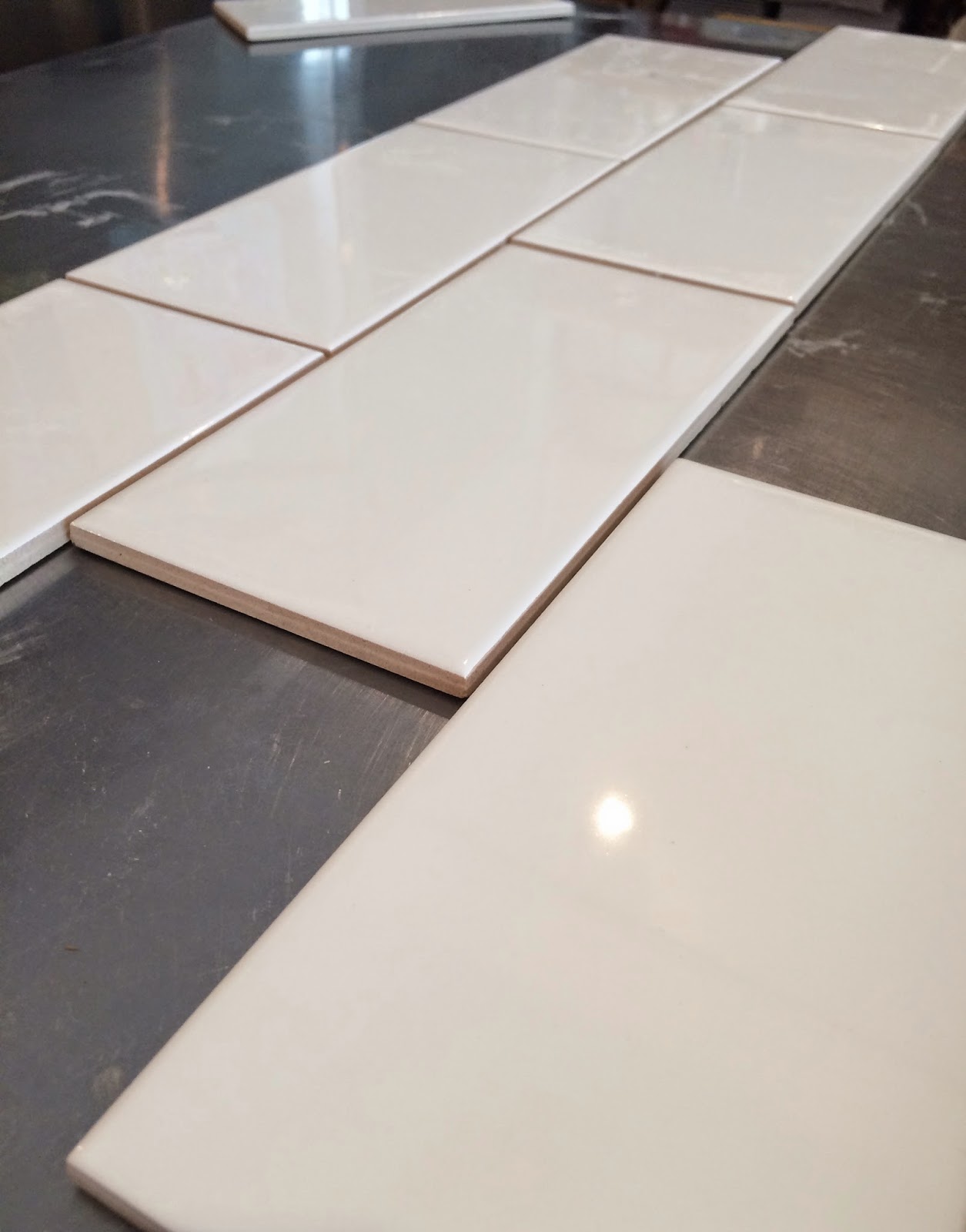
My initial ideas about the space was to have bare concrete walls with the wooden floor in the customer space, with bookcases around a mantlepiece, and perhaps a brown leather wingback chair. The kitchen was to have stainless steel, glass and also white tiles with black grouting, like I had photographed at Mornington Crescent tube station.

Flat white tiles and dark grouting

We ran into some challenges with this plan. The long thin tiles that I wanted were nowhere to be bought, any type of white tiles in fact were impossible to get for a short time in Japan! The tax increase in April meant that people had paid upfront in March for materials for projects in the upcoming months and all stock was already promised out to other people. There was nothing we could do but wait for some of these things until May.


Come May and the tiles arrived! We put them up offset like bricks, not in the more usual to Japan grid pattern. Here they are on the front counter, before and after we put the grout on. My glass screen in place too, my very own sushi counter ;)


Another problem we came across was with my idea about bare concrete walls. This is not as easy to achieve as it might sound - a number of builders I had consulted with advised against it as a waste of time and money, as the backing paper under he existing wallpaper was glued directly to the concrete of the space and would be difficult to remove. In the end I decided to have a go myself with a steamer, and I managed to clear a whole wall... only to find that the concrete under the paper wasn't the pure grey of my imagination but had a whole host of weird and wonderful colours that would look great on a painting, but were probably not the best look for a food establishment.


Instead, concrete-effect wallpaper then, with a slightly heavy heart is what I compromised with. Having worked in the space for a little while now, it has grown on me and I'm quite fond of it.


On one wall, and still to come as a refurbishment, will be some special wallpaper and a set of higgledy-piggledy framed portraits of some of my favourite people. I really fancied having flocked velvet wallpaper in a greenish hue, and got all excited when I found *the original* BBC Sherlock wallpaper from Zoffany available to buy online in the UK! I quickly ordered a few samples to be sent to my sister's house and she sent them onto me...


I narrowed them down to the two samples I liked the best. Recognise the one on the left in the image below? :) But which, oh which, did I end up choosing for that wall.... to be continued! (Once I bring the rolls back in my suitcase.)


Antonio made me a beautiful floor in the kitchen with this water resistant vinyl, which, with my red oven makes the space feel ever so slightly Lynchian :)


Here we've got the counter getting built, the big fridge/freezer in place, and the gas table in the corner. Antonio raised the height of the second-hand cold table and sink to gaijin-friendly 90cm (and my back thanks you, Tony!)


Starting to build up the bookcases and mantlepiece. Woo, moody! Still not sure if there is really space to have a leather armchair in there.


And here we have the largely finished effect. The most beautiful kitchen I've ever owned. It's such a luxury to have a large work surface, big fridge-freezer and 4 oven shelves to work with after struggling in tiny kitchens for such a long time.


On completion of this phase of the project Antonio gave me this amazing clock as a gift! A great craftsman with a sense of pride in his work, and a nice guy too. I'm so lucky :)


Just to think, once upon a time the space was only an idea..!

Thursday, June 5, 2014

Launch flowers in Japan

Catching up on a few overdue posts - When you launch a new business in Japan, if you're lucky you'll receive flowers to display at your premises to celebrate the opening.


These are usually from business partners and other parties related to the set-up of your shop, such as real estate agents, and they come with a card on a stick saying something like 開店祝い / kaiten iwai / congratulations on your new shop, and also including the name of the business who sent the gift such as XYZ不動産 / XYZ Real Estate Co. Aside from indicating to passers-by that a new business has opened in the space, these are also advertisements for the related companies, who might hope to get a little additional exposure.

You've probably seen a variety of large and small displays outside new businesses in Japan, from ostentatious flowers on tall stands outside the shop, to small displays of dried or 'preserved flowers' that don't require any upkeep.


A traditional offering would be orchids 胡蝶蘭 / kochouran. These are presented potted, in soil, to represent the wish for the new business to set down firm roots at the premises and flourish much like the plant.


It's a lovely, and quite practical tradition, and I was thrilled to receive a number of celebration flowers and balloons upon the opening of the business - all the more exciting as I hadn't expected that anyone would send them to my little shop. Thanks everyone!


Monday, April 21, 2014

The great unveiling! Welcome to Mornington Crescent Tokyo

Drumroll.... Today the dream became an official reality - At 3pm the hokenjyo lady visited the space and we now have our business permits!

Ladies and gentlemen, welcome to my little shop in Tokyo - welcome to Mornington Crescent!

A suitably stamped celebratory Battenberg :)

Mornington Crescent Tokyo begins life as a little baking school, teaching Great British Home Baking to small groups, and as an online shop with authentic British seasonal and cultural treats, deliverable across Japan by cool-bin refrigerated and frozen delivery services.

I, and almost everyone I have told about my until now secret project, would also love it to be a bakery/ cafe. While this phase of the launch doesn't yet include a regular cafe, we do plan to try out bakery days in the form of the "occasional bakery" - keep in touch on Facebook and Twitter to find out when!

The space itself is a cosy size, but I already love it. I lived in Higashi Azabu a few years ago for 3 years and enjoyed the close-to-Azabu Juban station yet back-street/small neighbourhood vibe it has. It seems that there is always a new restaurant or mom-and-pop shop to discover, and I really look forward to being a new and hopefully exciting part of the local community.

It's just a 3 minute stroll from Nissin supermarket, tucked in the back streets. There are a few cosmetic things still to finish at the space - the shop sign being made near my hometown in Greater Manchester and shipped over (can't wait!) and tiles for the kitchen walls etc. but we're more or less up and running.

To celebrate this soft-launch of the business we're doing a special offer launch box - 4 kinds of British treats for delivery in Japan. Please see the site for more details.

So yes, apologies for the dearth of posts over the past few weeks, it's been a busy and exciting time! There are many posts that I want to write about that process and so I plan to do so retrospectively. I have already learned so many new things through the process of getting ready to open that I am sure it would help other people looking to do something similar. I plan to continue the blog for now as well, I'm sure there is still much to learn and share.

Ah yes, and so this is me (hello!), the face behind the little shop in Tokyo blog:

Stacey