Monday, October 28, 2013

Are UK and Japanese Bramleys the same?

This is one of the most common questions among the Bramley aficionados here in Japan, and so I thought I'd do a small (and totally unscientific) test.

Lumpy, bobbly fruit vs. beautifully round orbs - which is which?

Here we have four randomly selected apples, roughly the same size. The two on the left are from an ASDA supermarket in the North West of England, and the two on the right are from Obuse, Japan.

At first glance you notice that the UK apples are very shiny - this is the wax that is applied to the skin which doesn't appear to be used on the Obuse fruits. The Japanese apples are also of a more uniform shape, almost perfectly round and much less bobbly.


The visual contrasts could be down to a cultural difference in how they are used. In the UK they are somewhat ubiquitous fayre, but in Japan they are still an exotic treat. Consider how Muji is quite the trendy design brand in the UK with just 12 stores (and is more expensive than in Japan) yet in Japan the 379 'no brand, quality goods' 無印良品 shop is in every medium sized train station and shopping area, and their goods carried in many convenience stores.

Another cultural difference is that fruit is often given as a gift in Japan, and so perhaps fruit is required to look exquisite here, in order to sell. Maybe they use the ugly fruit for wholesale and other purposes.


Incidentally, these bags of Bramleys (below) are of a more common size and colouring that you see in British supermarkets.


They are often bit smaller than Japanese ones and often have a little bit of blush on one side from the sun. They are currently £1.88/kg (just under 300 yen/kg) which is a little over a third of their price in Japan.


Cutting into the fruits you can see that the UK apples on the left seem to be a bit more open in the core - though, being a completely unscientific test, this could just be down to chance.

In the stewing down I found that the UK apples (again, 1st pic) fell more quickly into a puree and were perhaps slightly juicier. The Japanese apples (2nd pic) held their shape slightly longer.


Taste-wise, both raw and cooked, I found something slightly unexpected. The Obuse apples were possibly ever so slightly more tart than the UK apples, at least in these that were tested. I didn't expect this because I thought the warmer Japanese weather would cause for riper, sweeter fruit but this doesn't appear to be the case in this particular test. Again, some of these differences could be accounted for by the difference in starting temperature, as my Japanese fruit came from the vegetable crisper of my fridge.. this is not a rigorous test.


Most importantly anyway, the Japanese fruits definitely have that distinctive Bramley taste and will satisfy that craving just as well as the ones from back home. Very similar, perhaps the same, certainly similar enough!

No soggy bottoms here!

Friday, October 25, 2013

Choosing a bank for a small business in Japan

I'm currently going through the process of incorporation with the help of a lawyer (updates to follow!). Once you're incorporated you can open a company bank account. I've been calling and visiting banks in Tokyo, looking into a few options and thought I'd share some of the findings.


Firstly, opening a bank account for a business in Japan usually requires a kind of 'applying to apply' - a vetting procedure, through which some applicants will be rejected. It is an anti-fraud measure, and is all about proving that you are a legitimate business.

There are two main types of high-street bank in Japan 都市銀行 / toshi ginko "mega banks" like Mizuho and Resona, and 地方銀行 / chihou ginko (or 第二地方銀行 / dai ni chihou ginko) which are regional banks such as Chiba Ginko or Kansai Urban Ginko. According to this (other and very informative) blog about setting up a business in Japan, the mega banks currently appear to be less difficult to get an account with than the regional banks.

In either case, initial documents to submit for opening a business bank account in Japan usually include the following (though they will of course will vary by bank):
  • 履歴事項全部証明書 / rireki jikou zenbu shoumeisho - Certificate showing the complete records of your company to-date, from your local legal affairs bureau (法務局 / houmukyoku).
  • 法人の印鑑証明書 / houjin no inkan shoumeisho - Official company seal certificate, also from the legal affairs bureau from within the last 3 months.
  • ご本人を確認する公的資料 / go honnin wo kakuninsuru kouteki shiryou - Officially recognised proof of identity of the person submitting the application (such as a driver's license or Japanese medical insurance card).
  • 社員証等 / shainsho tou - Proof that you are employed by your company (company ID card, a business card, possibly a copy of your contract or employment agreement - 雇用証明書 / koyou shoumeisho or certificate of enrollment 在籍証明書 / zaiseki shoumeisho - especially if you're a small company and don't have an official company ID card).
The above listed documents should be originals rather than copies. If the company is new, they are also likely to ask for the following:
  • 定款の写し / teiken no utushi - Copy of your certificate of incorporation.
  • 法人設立届出書 / houjin setsuritsu todokedesho - notification of incorporation as submitted to the tax office, probably by your accountant when you incorporated.
  • 給与支払事務所等の開設届出書 / kyuryou shiharai jimusho tou no kaisetsu todokedesho - the tax report for commencement of payroll as submitted to the tax office by your accountant when you incorporated.
  • An explanation of your company's activities and what you plan to use the bank account for.
Once they've had a look at these (which I believe can take up to 2-weeks), they may contact you for additional information to help your application - this could be administration documents such as invoices/purchase orders, pay slips, or promotional materials such as company brochures, and even to see the tenancy agreement for your premises, or actual products you make or sell etc.

If you are successful in applying you will be able to go and pick up your bank book and open your account. If your application is rejected then try to find out why and try again at a different bank, as requirements vary.

Depending on the size of your business and what you do, there will be various things to consider when choosing who to try applying with first:

Japanese Q+A sites often recommend that small business owners just choose the bank that is closest to your business, as you may have to (or want to) physically visit the bank to make transfers and do payroll etc. Indeed, closeness is usually a requirement from the bank too - if you want to open a Mizuho account for example you will need to go to the nearest branch to your company address for them to accept your application. If you are using a virtual office, make sure to check your plan's details to see if you are allowed to use that address to open a bank account.

Aside from location then, here are some additional points you may want to consider and ask your prospective bank about, or discuss with your accountant:
  • What are the fees for making domestic bank transfers? (Compare wire transfer charges for the same vs. other banks)
  • What are the fees for sending and receiving international bank transfers?
  • Do they have good ATM coverage in your area, what are the daily transfer limit options and transaction fees at ATMs?
  • Will you need online banking, is there a monthly fee for the service? 
  • Will it be easy for your customers to do bank transfers to this bank (does it show up on the bank list of your personal online banking for example)?
  • Is there a fee for creating a cash card? Mizuho's cash card costs a one-off fee of 1,500 yen, MUFG cards are free.
  • Do they offer a corporate credit/debit card and is there a fee?
  • Can you check your account on your phone to quickly confirm payments received etc?
  • Do you have to keep a minimum amount in the account?
  • Can you set up auto payments/standing orders?
  • How do you pay salaries, and is there a limit on the number of staff for each service tier?
  • Will you need to export information directly to any accounting software?
  • Do they offer any financial advice for small businesses?
  • What are the company's future needs and ambitions? Will you be asking for a loan?

It's worth knowing that although there are usually no basic monthly costs for having a corporate bank account, Internet banking is usually an add-on service for the big banks, and is not included by default when you open an account. Differently to their personal Internet banking services, the high-street banks usually charge monthly fees for corporate Internet banking.

Here are a couple of the main "mega" Japanese banks, along with information about their online banking services for business:
Considering the free Internet banking 'light' service and no charge for a cash card, MUFG appears to be the least expensive option.

Another cheap and handy option could be using an Internet bank (often referred to as ネット銀行 or ネットバンク/ netto ginkou or nettobanku) where the monthly online banking service fees are often 0 yen, ATMs are widely available at convenience stores, and most of the transactions are also cheaper than the online banking services of regular high-street banks, as you can see if you enlarge the table below.

Comparing online bank transfer charges - click to enlarge

Here are a couple of the main Japanese online banks:

If you're a small business, the cost of making transfers for payroll, partners and suppliers can add up to a considerable expense - a company I know of in Tokyo with just under 10 staff spends an estimated 50,000 yen a year on transfer charges alone. In fact, some large Japanese firms have their new employees open a bank account with the same bank the company uses so that the company can benefit from reduced transfer costs.

Another advantage with using an online-only bank is that if you're wanting to set up a bank account before you've found a permanent location you could start off with an online bank and then open an account at a high-street bank once you know your new address.

However, bear in mind that depending who you plan to do business with, it is possible that having an account at a large high-street bank may feel more reassuring for your partners and customers than an online-only bank, this is probably the biggest down-side to consider. Some Internet banks such as Rakuten Bank also require that you have an existing high-street bank account before you can open a net-banking account with them.

This information was correct to the best of my understanding at the time of writing, but I imagine the fee data in particularly will quickly be out of date, so please do check the links to the banks' own sites for the latest figures.

Monday, October 14, 2013

Can Bramleys make it big in Japan?

I've done quite a few posts about how great I and members of the Bramley Apple Fan Club here in Japan think Bramley apples are, and about their story here, but what about Japan in general - what are the chances of these cooking apples being a hit over here?


Indeed, don't I have my work cut out for me in general, starting a business based around British sweets when so many of them are unknown here and not very, erm, 'elegant' in appearance?

Let's begin with the taste - I did a little experiment recently, sending a few pies to friends in Kyushu to see what they'd make of their first taste of Bramley apple pie. The feedback was mixed.. "certainly unique, I think I like it" but "too sour, almost like vinegar! The little kids couldn't eat it" gosh.

True, I'd held back a little on the sugar a little with the idea that Japanese people prefer subtly sweet desserts (甘さ控えめ / amasa hikaeme), but it certainly seems that further experimentation is needed. Comparing a few well known British chef's Bramley apple pie recipes, sugar ranges from 10-20% of the weight of prepared apples, though it of course also depends how tart your particular apples are to begin with and whether you add lemon juice to stop them browning etc.

At the recent Bramley apple lunch I sat next to a master pâtissier, owner of a famous French-style cake shop in Tokyo who has been using Bramley apples for 15 years. He said that using enough sugar with the Bramleys is important as it brings out their 'umami', and talked about how butter also enhances the natural sweetness in the apple.

It's going to be important to find just the right balance, as people with Bramley cravings would be most disappointed to have the unique flavour smothered in a sweetness too syrupy. Challenge!

How the pie is explained to customers will probably be the key to the chance of a positive first encounter - someone expecting American style apple pie might end up a bit shocked tasting a spoonful of British style pie. Like when I first tried kombucha - I was told it was "tea" and expected something astringent and bracing and had quite a shock with a mouthful of salty broth. If it had been described to me as tasting like soup I may have liked it immediately!

Additional challenges for apple pies and various rough-and-ready English desserts in Japan come from their appearance and use. My friends in Kyushu were concerned that people might not be able to cut neat slices out of the pie with the filling being puree rather than the slices of fruit that they are used to seeing in apple pie. Similarly, attendees at the Bramley lunch told Celia that things like the apples cooking down to a puree and juice/jam leaking from the top of the pie are often seen as failures in Japan - all things that are not problems at all for the enthusiastic British family waiting to dig-in after dinner.

Being unpretentious and not too fancy makes these desserts somehow more genuine, certainly more authentically British :) Are we too serious for frills, embarrassed by something too showy? The French friends in this funny and savagely-written article may have a point "This so-called 'baking' is not patisserie, it's masonry".

These kinds of dishes are firstly comfort foods in the UK, good honest treats made at home for sharing. In Japan however, perhaps more of my customers would be wanting to use them as gifts, and perhaps they'd prefer individual portions of something a bit neater-looking.

Still lots to think about and tinker with then, and I imagine that things will need to evolve during the course of the business too.

There is definitely something special about the flavour of Bramley though, and I think it will win many more Japanese fans - that balance of acidity and sweetness is mouth-wateringly craving-inducing once the taste has been acquired. After all, it has been charming people for over 200 years.

So yes, I can see Bramleys being fiercely popular with those people it wins over in Japan, though it might take a couple of encounters with the fruit to get there.

Monday, October 7, 2013

A real slice of Bramley apple history!

Last weekend I was lucky enough to be invited to the annual ブラムリーを楽しむ会 / Buramuri wo tanoshimu kai / Bramley apple lunch held by the Japan Branch of the Royal Horticultural Society, Obuse town and the Bramley Apple Research Group - and there had an encounter with Bramley apple history!

Celia Steven, great-granddaughter of Henry Merryweather who was the first person to cultivate and sell the Bramley apple in the UK, was visiting Japan for the first time and attended the event which was lead by Mr Arai – the person who helped bring the first Bramley trees to Japan in tandem with the RHS 23 years ago.

Celia presents Arai-san with a "Southwell time" apple clock

Members of the Bramley Apple Fan Club who were instrumental in forming the connection with descendants of the Merryweather family were also present (see the fan club's report here in Japanese), along with eminent Japanese pâtissiers, food writers and British food and culture enthusiasts.

Celia is very active in the UK in the promotion and education about the Bramley apple and its history and has now also visited Obuse, the first home of Bramleys in Japan. There with the help of local schoolchildren she planted a tree, which will perhaps come to symbolise the growing bond between Obuse in Japan and Southwell in Nottinghamshire, the home of the first ever (and still living!) Bramley tree.

Celia-san, descendant of Henry Merryweather

Greeting the attendees, Celia gave a beautiful speech in Japanese and went on to talk about how warmly she and her family had been received in Japan, by Obuse town, various Bramley friends and even strangers in the street. It was very evident, she said, that the Bramley was very well loved in Japan by people such as the attendees of the lunch who had already encountered it, and that how it is used in all kinds of dishes here demonstrates its versatility and uniqueness as a fruit.

She was eager to take back to the UK and British schools stories of Obuse and Japan’s growing affection for the Bramley apple, to share some of the novel ways it is being used here, and to use the Bramley to strengthen the bond between the UK and Japan through things like activities with schools and cultural festivals.

Arai-san, the man who helped bring Bramleys to Japan

Another guest of honour at the event was Seiko Hirota a director at the RHSJ, who lead the toast resplendent in a Liberty apple patterned outfit. Hirota sensei was involved in the selection of the Bramley apple from among four possible cooking apple choices to be officially introduced to Japan for cultivation.

The toast was poetic, Hirota-sensei spoke of how the apple has been a powerful symbol in stories throughout history - Adam and Eve in the garden of Eden, the Judgement of Paris using a golden apple, the poisoned apple of Snow White, and now the Bramley with its unique charm and power to connect people.

Despite this power and ubiquity now in the UK much of the Bramley’s journey to-date feels almost serendipitous. Without the little girl Mary planting pips over 200 years ago, and without Henry Merryweather noticing the fruit they would not be around today in the UK, and without Arai-san wanting to bring the apple to Japan and the RHS selecting it above the competing fruit we would not be able to enjoy them here.

Our Bramley lunch menu, and recipe for the soup

Without further ado here are some of the dishes from the day's Bramley-packed lunch at Tokyo Station Hotel's Blanc Rouge restaurant. The menu was carefully designed so that fans of the Bramley could enjoy it in a variety of incarnations and so that Celia and family could try notes of Japanese cuisine and regional Shinshu produce from Nagano. (Incidentally Tokyo Station, rumoured to have been modeled after Amsterdam central station, has been beautifully renovated to celebrate it's 100th anniversary in 2014 and is well worth a look - and do look up!) :)


The starter was smoked salmon and grilled iwana from Shinshu (Nagano) with a Bramley sauce.


The chilled soup was from the recipe in the photo above, with both cooked and raw bramley prepared with yoghurt and white wine - an amazing taste, it was lovely. The main dish was Normandy style quail with dauphinoise potatoes and Bramley used in the sauce.


The dessert was gyuhi mochi forming a very delicate parcel containing Bramley, dainagon and chocolate, which was quite a unique flavour combination.

I was so excited to be there I'm ashamed to say that I forgot to take photos of the brioche amuse bouche and the wine. I talked so much in fact that I kept holding the waiters up..

After lunch those who wanted to hear more decamped to a small room for continued Bramley banter with Celia and Arai-san.

Decamped to a side room for a bit of post-lunch Bramley banter

Topics that came up included questions to Celia about how Bramleys are used in UK apart from pies and whether British men cook ("roast pork with apple sauce, apple crumble" and "some most definitely do" respectively). We also discussed the current 'Food is Great' campaign of the British Embassy in Japan which appears to be designed to address the troubled reputation of British food here.

Celia also gave top tips on how to judge an apple pie, having judged many competitions herself: "the apples are always great, judge the pastry. There are to be no soggy bottoms" It also became apparent that pie filling bubbling to the top of the pie or crumble is not necessarily seen as a baking failure in the UK as it might be in Japan, but rather gives the dish character.

When I first thrilled at my discovery of Bramley apples in Japan, I knew nothing of their fascinating history in the UK (despite having lived in Nottingham!) or their journey over here and who was involved. Imagine having to come all the way to Japan to learn about my own culture. :)

History, culture, and international relations are vibrantly alive in the Bramley story, and with such passionate advocates on its side we can look forward to see how the next chapter in the Bramley apple’s adventure will unfold (or unpeel? Sorry.. :) ).

Looking into the future... I mean, the ceiling of Tokyo station

Wednesday, October 2, 2013

Field Trip! – Obuse Town, Nagano

A series of posts from visiting interesting little (and large) cafes, food-related establishments and other places of inspiration.

As part of the 2013 Bramley Apple Tour I wrote about previously organised by the Japan branch of the Royal Horticultural Society we got to have a bit of a look around the atmospheric Obuse town centre and it was so pretty and interesting that I thought I’d do a bit of a write-up in case anyone else wanted to make a trip up there. There is also an excellent .pdf guide in English about Obuse here.

Bramley and a friend - the Obuse nasu

Going to Obuse can be a bit of a train geek’s dream – I didn’t think I was a train geek at all, but I was all 'wow!' and 'squee!’ on the way there, first on the shinkansen to Nagano, and then on a cute and dinky “romance car” style train with viewing cars at the front and back. It being during the week I got the whole observation car to myself. It was only a few hundred yen to get to Obuse from Nagano and quite bubble-era luxurious. There are regular trains on this line too, I was just lucky with timing. Oh, and no paying with suica cards on this line! Yes this was a proper field trip, with real tickets to be clipped by real station masters.


We were greeted by the tour leaders from Obuse-ya at the station and ferried by bus to a local restaurant called Hanaya (flower shop) which had a view onto a lush green English style garden, for the welcome greetings and a Bramley-themed lunch.


The food at Hanaya was outstanding, with innovative uses of Bramley apples and other local ingredients, such as a peculiarly rotund type of aubergine that is grown here. The meal started with a delicate salad with prosciutto and what seemed to be Bramley oroshi.


The soup was pumpkin potage with crab and Bramley.


I had chosen the fish course and it arrived as a pie that also contained Bramley apple and was served with a curry sauce and (partially concealed in this photo) a slice of Obuse aubergine painted with miso paste. This course was excellent.


Crepe with Bramley puree and ice cream.


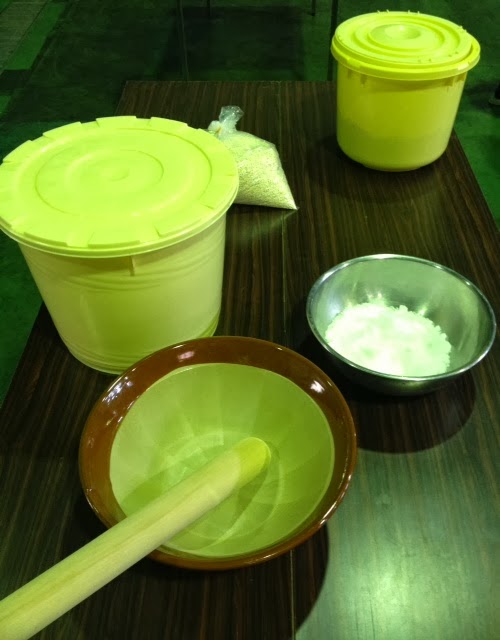
After lunch we visited a miso factory and shop for our hands-on miso paste taiken! I had a vague notion that miso was a fermented bean product, and knew that I absolutely love it, particularly as soup, but I did not have a clue how it was made or that it was so easy.


We squished cooked soya beans into a paste, added lots of salt and malted rice / kome kouji / 米麹 along with some of the cooking water, and mixed well with our hands. We then took turns throwing big blobs of it into the base of a bucket until all our mixture was in the same pot, and this was to be stored for several months to ferment, at which point it will be posted to us.

Barrels and weights used in making miso

The gentleman from the miso shop who lead the activity explained that Japanese people are eating less traditional food than before and that the consumption of soy sauce (which the company also used to make) and miso is in decline. He mentioned various health benefits of miso including a study that suggested that it does not increase blood pressure, despite it being so salty (possibly due to the effect of fermentation with lactobacillus - this is unclear, or perhaps because salt might not actually lead to high blood pressure!). However the only conclusive study I was able to find about miso and blood pressure was done on rats rather than people. Either way it's tasty stuff and well worth eating regardless of possible special health benefits.

With many types of traditionally made miso taking months, even years to mature this is a real ‘slow food’, and with the koji fungus in the kome koji as a kind of 'starter' added to the mix, it struck me as being similar in some ways to sourdough bread. Fermented foods are enjoying a bit of a renaissance in the UK, perhaps miso will be part of the trend there too.

Buckets of different types of miso paste

The shop has excellent miso for sale (and online), indeed you can find Obuse miso all around the town. Speaking of which, in the afternoon after our trip to the Bramley orchard we had free time in the centre of the small town.

Miso shop near the factory

Aside from apples, chestnuts and miso, Obuse is famous for having the Hokusai-kan museum, which is home to many of Hokusai's famous prints and paintings and would be worth a trip on its own. The area around the museum is an extremely pretty and well-designed artistic impression of the historic town itself.

Many of the buildings are in fact new, but they have been made to have a traditional appearance. Some of the shops are a beautiful mix of old and new so it’s a lovely area to stroll about in, trying different flavours of ice cream, tasting sake and buying snacks to take home. I can imagine it would be quite busy during national holidays and certain times of the year. Another particularly nice area is around the sake brewery's 煙突 / entotsu  / chimney, which has a cute courtyard, entotsu cafe and some unique buildings.


We rounded off our whistle-stop tour of Obuse town with a visit to a well known patisserie, Rond-to, where we sampled a delicious French take on a Bramley apple cake. It’s an airy little cake shop with a café and a couple of seats outside in the European style. The property used to be a fish shop and so they had a lovely big kitchen where I could peak through at the staff having fun preparing items for the shop.


Other things in the area that I did not get chance to visit on this trip were the nearby winery, and a hospital with an interesting story connected to a bakery.

The story goes that there was a Canadian nurse working with tuberculosis patients at the Anglican Mission hospital here in Obuse in the 1930s. Apparently she liked English Chelsea buns, and missed being able to have them when she was in Japan. A local baker attempted to make the buns for her based on her description, but they weren't right. He tried many times without success before finally producing something so perfectly ‘Chelsea bun’ that it moved the nurse to tears. The hospital (still functioning) and the original bakery is still there to visit, and there is a lovely children’s book with the story that is written in English and Japanese.

International relations through baking, it's possible! :)

Bi-lingual story of Chelsea buns in Obuse

For even more information about Obuse and a local onsen listing have a look here.

Tuesday, September 10, 2013

Field Trip! – Obuse, the Bramley apple's Japanese home

A series of posts from visiting interesting little (and large) cafes, food-related establishments and other places of inspiration.

Last week I had the pleasure of visiting Obuse for the first time, right in the middle of Bramley season.
I participated in a tour organised by the Japan Branch of the Royal Horticultural Society in cooperation with Obuse-ya, which was to take us to try out all kinds of Bramley-based cuisine, see the picturesque town of Obuse and pay a visit to the Bramley orchard itself and meet the current farmer (nurseryman?).

This post is all about the apples themselves, I’ll write more about Obuse town (it is lovely) and the rest of the tour in a follow-up article.


Bramley apples are a type of cooking apple. Britain is reported to be the only country that cultivates apples specifically for cooking. Bramleys accounted for 91% of the UK cooking apple market in 1989 and is possibly now 95% (data unverified), which was 4% of the total UK apple market in 2012.

It’s probably safe to say that they are now the most well known and loved of all apples in the UK when it comes to making apple pie. As I wrote previously upon my first happy discovery of Bramleys in Japan, they make a completely different type of pie compared with those made with dessert apples.

Bramleys are very tart if eaten raw (they are rarely eaten raw in England - we were always told not to as children), but when cooked the flavour mellows and, even with the added sugar used in most recipes, the final taste retains a perfect balance of acidity and sweetness. Another characteristic feature is that they cook into a puree rather than the slices holding their shape or becoming dry and chewy.

It was the unique taste that impressed Arai-san during a trip to England and that moved him to work with the Royal Horticultural Society to bring the trees to Japan 23 years ago. The first fruit was grown in Obuse, Nagano.

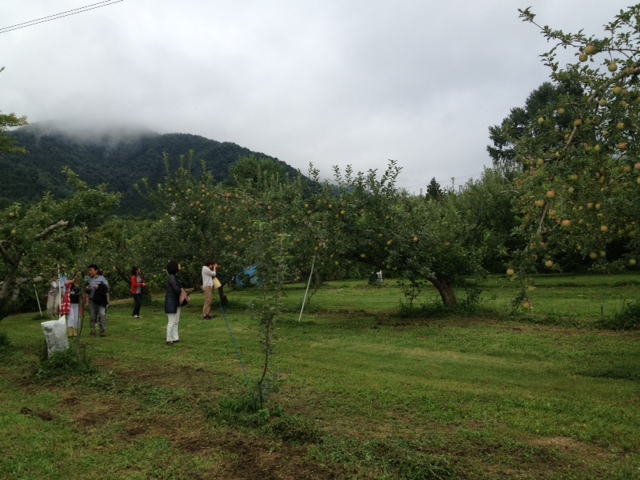
Nearby the orchard in the hills of Obuse

Up in the hills of Obuse 600 meters above sea-level the air is markedly cooler than around the station, and about 10 degrees cooler than it was in Tokyo on the day I visited. By the time we left it was positively brisk – a homely climate for a British apple.

Looking towards the Bramley corner

The trees in the Bramley corner of the orchard were unexpectedly short, we stooped and weaved under the branches towards a group of crates pulled into a circle in a clearing. It might be the distortion of memory or my comparative smallness at the time, but I seem to remember our Bramley trees towering over us at the bottom of our childhood garden.

Thanks to extensive planting throughout the early 1900's, many British families have a Bramley apple tree in their garden or know someone who does and who wants help using up their glut of apples in October - at least this was the case when I was growing up in the North of England. Even if you didn't have your own supply you can get the fruit inexpensively at most British supermarkets, especially in the Autumn.


It turns out that their height, and many other aspects of how the trees have been cultivated in Obuse are deliberate choices to improve yield and quality in the Japanese growing context. For example Japan, even the cool hills of Obuse, is sunnier than the UK and so shade is created by crowding the canopy of the low-slung trees together somewhat, shielding most of the apples from direct sunlight to keep them a deep green colour rather than them turning blush-red in the sun.

Stouter trees apparently give a better yield, as evidenced by the boughs heaving with fruit despite some already having been harvested. Again, the un-managed garden trees from my childhood could not compete with the Obuse trees in terms of output.

So many Bramleys!

Another difference was that many of the Obuse apples are as big as your hand – when the fruits start to form earlier in the year they remove 4 out of the 5 buds in each cluster, thinning out the apples to leave a ‘king fruit’ intact to grow to its full size potential – something we certainly never did with our trees at home! Even when you buy them from the supermarket in the UK they tend to be on the small-side compared to many of these Obuse apples.

For all their culinary glory, Bramleys can be a bit of a dumpy-looking, bobbly fruit. In the UK they often come in various sizes and are not too pretty – they are for cooking after all.

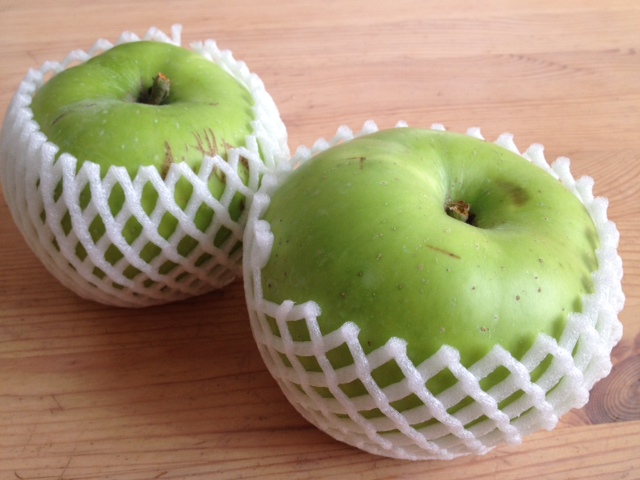
Having received perfect, huge and unblemished Bramleys in the last couple of years from both Obuse in Nagano and Hokkaido I had wondered if perhaps their cultivation in Japan had involved the careful practice of wrapping each fruit in paper as it grew on the tree (something I've seen for grapes, melons and oranges here), but this didn't appear to be the particular method used here. In any event, Japan is well-known for extremely careful and labour-intensive farming practices that produce perfect-looking fruit, and their Bramleys are no exception - they were prize-winning fruits. (Below, my order fresh from Obuse.)


Sat in the crate-circle having our Bramley-themed snacks and exchanging Bramley-themed recipe tips with other participants on the tour, the slightly musty smell of the orchard reminded me of my old garden. I'm still trying to decide whether I think the Japanese Bramleys are slightly less tart than the British ones, but need to try one from home again to compare. ;) (Incidentally, it appears that some of the tartest Bramleys are currently grown in County Armagh in Northern Ireland.)

We met Oshima-san the farmer who talked about how he and his wife came to manage the orchard 3 years ago and how they are learning the pleasures and idiosyncrasies of the Bramley. He explained the different tasks involved in caring for Bramley apple trees throughout the year and said it was often hard to spot all the fruit compared to other apples at harvest time because the Bramleys are so well camouflaged in the green.


It was interesting to see how Bramley stock had been grafted onto pre-existing trees so that mature, thick-trunked trees could bear so much fruit so quickly, despite only having been cultivated here in Japan for just over 20 years.

White material shows where a graft was made

Oshima-san's talk was punctuated by soft sounds of ‘fudunk.... fudunk’ as here and there an oversized apple released its hold on the branch and fell to the ground.

I had previously been surprised to learn that there is a known original Bramley tree, and that it is still alive and producing fruit in Southwell, Nottinghamshire.

The story is that a little girl named Mary Ann Brailsford took seeds from apples her mother was preparing in the kitchen and planted them in pots. One of the seeds successfully germinated and was transferred to the garden. Many years later a Mr. Mathew Bramley owned the cottage and agreed to let Henry Merryweather, son of a local nurseryman, sell some of his apples under the condition they bore his name - the fruit were named 'Bramley's Seedling' apples, now shortened to Bramley. (Lots more interesting detail on the history here.)

All existing Bramley trees are from "grafted cuttings of grafted cuttings taken over many generations" (interesting article) starting from that original tree and diversifying over time. In 2009 the tree passed its 200th birthday and is being protected against disease in its old age with the help of Nottingham Univeristy scientists and groundsmen. The scientists have also cloned the Southwell tree to preserve the exact original taste (thanks to its higher vitamin C levels) and quality of fruit that captured the interest of Henry Merryweather in 1856.

Celia Steven (née Merryweather), great-granddaughter of the nurseryman, continues to promote Bramleys and has even had to fight for the preservation of the fruit in the UK when EEC regulations appeared to threaten their future in the 1970's. In a wonderful turn of events for Bramleys in Japan, Celia and family will visit Japan and the Obuse orchard later this year!


From Henry Merryweather almost 200 years ago to Arai-san over 20 years ago, the unique flavour of the Bramley apple continues to charm people who have the chance to try it, first in the UK and now increasingly throughout the world.

Two apples I picked myself at the orchard :)